
For decades, the philanthropy was understood as an act of charity: donations of food, clothing, and resources aimed at alleviating immediate crises. While these actions have their value, they often fail to address the deeper causes of social and environmental challenges.
Faced with a scenario full of structural problems, the following arises: strategic philanthropy as a response. She proposes an action of long term, based on measurable impact and systemic changes. In this new paradigm, everyone has a role: governments, companies, civil society and, with special emphasis, entrepreneurial families, which have been promoting significant social and environmental transformations.
The role of family philanthropy
Unlike one-off or impulsive actions, family philanthropy is driven by a sense of legacy, continuity and intergenerational social responsibility. According to the study Philanthropizing, sponsored by the Beja Institute, philanthropy in Brazil it has almost doubled in the last decade — a jump driven mainly by the alignment with vfamily values, O promoting social responsibility and the creating projects that unite different generations around a positive impact. These values are passed down through generations, shaping a more strategic and lasting culture of giving.
Furthermore, the involvement of family as a whole contributes to the formation of a common identity around causes that reflect its principles. This approach strengthens not only the social impact generated, but also the emotional bonds and the vision of the future shared among family members. philanthropy, in this context, becomes an instrument of continuity and transformation, capable of uniting tradition and innovation in the search for structural solutions for the country's social and environmental challenges.
And there are signs of a promising future: the second part of the study reveals that 74% of the millennials (people born between the 1980s and 2000s) consider themselves philanthropists, a much larger number than the 35% of baby boomers (those born between 1945 and 1965). This is a change in mentality that can significantly leverage the role of philanthropic families in Brazil, especially if we consider that this is the generation that will soon be in charge of managing family assets.
How are family offices acting?
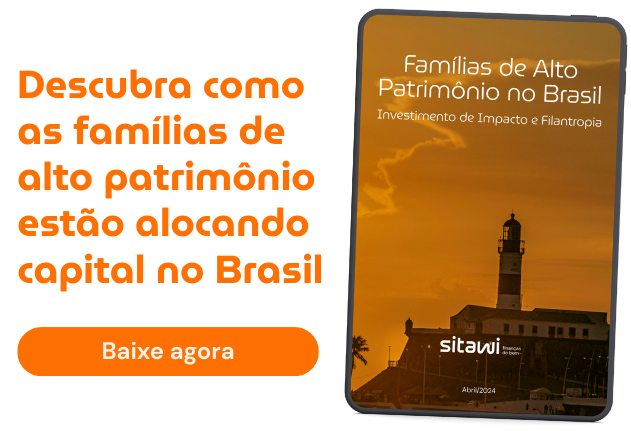
The research High Net Worth Families in Brazil – Impact Investing and Philanthropy, published by Sitawi Finanças do Bem in 2024, investigated how these families have allocated their philanthropic resources.
Twenty-one family offices participated in the study — 12 single-family offices (SFOs) and 9 multi-family offices (MFOs) — with assets ranging from R$50 million to over R$1 billion. Although the sample is small, it provides an valuable photograph of the philanthropic practices of this public.
The data reveals a major challenge: despite 83% show interest for philanthropy, only half engage in it systematically. More than 25% do not even adopt an annual giving pattern. This disconnect points to the need to integrate philanthropy into regular wealth management practices, especially in MFOs, which have not yet fully incorporated this dimension.
Other findings reveal that donations go beyond the Southeast region, also reaching the Northeast, the Amazon and even abroad. Sustainable Development Goals (SDGs) are used as a reference in the allocation of resources — albeit in an incipient way.
Among the most frequent types of support are: emergency donations and support for the training and structuring of social organizations (short and medium term). On the other hand, philanthropy focused on political incidence and advocacy, with a focus on long-term changes, is still little explored and receives a modest amount of resources.
Opportunities to advance
For the Family Offices, a philanthropy represents a legitimate way to expand social impact. However, obstacles such as lack of expertise and absence of clear mandates still limit their transformative potential. It is essential:
- Train asset managers in philanthropic practices;
- Encourage the creation of its own institutes and foundations;
- Establish governance mechanisms to align family strategies with philanthropic decisions.
Sitawi's research shows that many families already express a desire to institutionalize their philanthropy, but this desire is not always realized. It's as if we haven't yet found the way to Philanthropy and wealth management go hand in hand to maximize the socio-environmental legacy.
How can family offices structure impact philanthropy?
To support families interested in structuring their philanthropic journeys, the LGT Private Banking launched the Guide to Strategic Philanthropy, which presents some essential steps to transform good intentions into concrete impact:
- Alignment with your causes: understand your values, resources, skills and networks. Philanthropy is also about what you can offer beyond money;
- Understanding the root causes: go beyond the symptoms and investigate the structural factors behind social and environmental problems;
- Systemic vision: analyze the context, actors, public policies and market dynamics to identify levers for change;
- Scenario analysis: do research, map stakeholders, existing solutions, gaps, opportunities and partners to start your work;
- Theory of Change: develop a logical model that explains how your intervention will lead to the desired impact;
- Planning and implementation: structure strategies, schedules, partnerships and budgets to ensure coherence between intention and execution;
- Impact assessment: monitor short, medium and long-term effects, results and impacts, and use the lessons learned to improve your actions.
How to put it into practice?
For families who want to structure their philanthropy in a strategic and responsible manner, Sitawi Finanças do Bem offers two complementary paths: Philanthropic Funds and Endowments.
Philanthropic Funds
One philanthropic fund is a financial mechanism that centralizes resources from different sources, earmarked for causes with a positive impact. It offers convenience, scalability, transparency and efficiency for donors, beneficiaries and managers. The family can decide who they want to support, how often, and receive periodic accountability reports, without having to create a new CNPJ to manage the resources directly. All technical and operational aspects can be carried out by a specialized intermediary organization, such as Sitawi.
Equity Fund
You equity funds, or endowments, are widely used to ensure the financial sustainability long term of a cause. In the family context, they are also a powerful tool for preserving values, aligning capital with purposes and leaving a lasting legacy.
THE Endowments of Brazil, in partnership with the Sitawi, offers an innovative approach to the creation and management of these funds. With a focus on security and compliance, the operation follows the guidelines of Law 13.800/2019, ensuring a solid and transparent structure.
Furthermore, it is possible to direct the income generated to various causes or institutions, in a flexible manner and in line with the family office's preferences. Even many years after the fund was created, or even after the death of the founders, the resources will continue to be allocated according to the defined purpose, perpetuating the impact generated.
Do you want to structure your family office's philanthropy with more strategy, transparency and impact? Talk to the Sitawi team and find out how we can help.


