By: Raissa Testahy with collaboration from Ronnayana Silva
In the heart of the Médio Juruá Extractive Reserve, in the Novo Horizonte community, many women stand out for their stories. We spoke with Dona Neves, a woman who stands out not only for her personal story, but for her determination to change paradigms and strengthen the role of women in the region, located in Carauari (AM). Maria das Neves, 49 years old, is a living example of the transformation that has occurred over the years, and her journey is an inspiration.
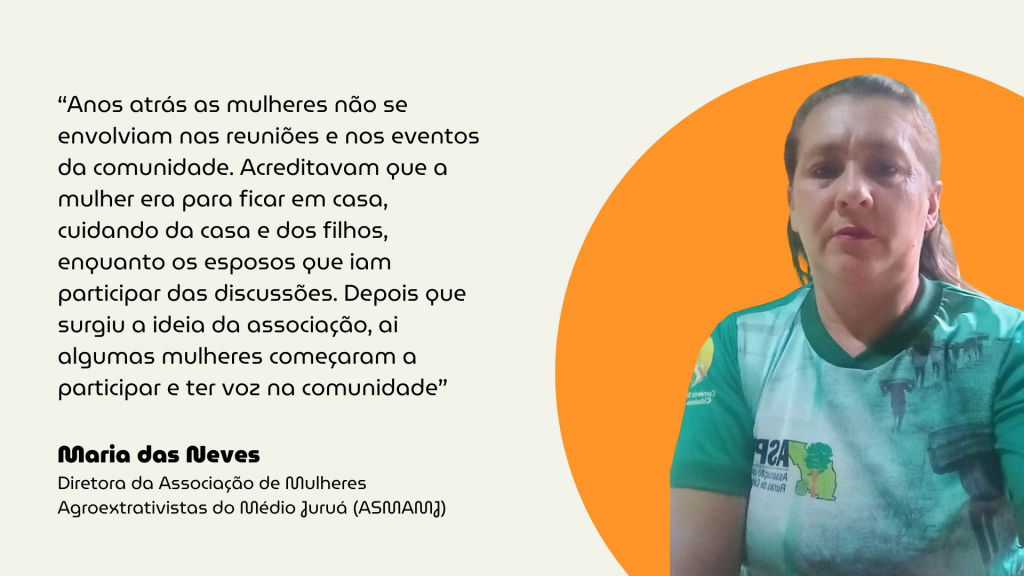
Dona Neves witnessed the underrepresentation of women in community activities from an early age. She shares how women were often relegated to the role of caregivers, while men took charge of discussions and important decisions. However, Maria was not content with this reality and became a leading voice in her community.
Finding your voices
His journey began early in the fields and in the production of flour. At the age of 16, he was already helping to sell community products and taking them from the community to the city, together with the Association of Rural Producers of Carauari (ASPROC) through Comércio Ribeirinho.
“One of the biggest challenges was that we didn’t have our own transport to transport the products, so we often lost the products,” he highlights.
She is also linked to the Association of Agroextractivist Women of the Middle Juruá (ASMAMJ), of which she became director in 2018 — a role she has held with pride. She recalls the days when women were afraid to actively participate in collective activities and decision-making spaces. With continuous efforts, including articulations and conversations, they are increasingly losing their fear and apprehension about participating and finding spaces for their voices.
Ms. Neves’ motivation for joining the organization came in part from the struggle of her father, Mr. Elson Pacheco, one of the founders of ASPROC, a battle marked by threats and resistance. Mr. Elson is one of the main leaders in the region and actively contributed to the recognition of the Médio Juruá RESEX. Ms. Neves is currently one of the directors of ASPROC.
“My father was very exploited by his [so-called] bosses. He fought a lot, he was threatened with death for defending the poor, I saw all his suffering. We could not live like that anymore. Then I understood the importance of us fighting for our rights.” highlights Maria.
The female presence in agroextractivism
Among the most important moments in her career are the ASMAMJ assemblies, where women have space to express their difficulties and contribute to the planning of the association's actions.
“It means a lot to me when we women are invited to other places, other communities, to debate and discuss improvements in the lives of other women. We have the opportunity to represent our community and help each other,” highlights the former director.
Today, it works directly with the flour and açaí production chains and in the production of biocosmetics.
About ASMAMJ
ASMAMJ was created in 2004 and works to promote unity, social and financial development of women in the region, raising the debate on gender equality and questioning attitudes that are considered oppressive. The association is one of the organizations implementing the Médio Juruá Territory Program (PTMJ), coordinated by Sitawi.
ASMAMJ's main activities include actions for women's health and well-being, skills development training, and strengthening of the region's biobusiness production hubs. The actions to generate income are called production hubs – biocosmetics, biojewels with scales, andiroba oil and essential oil.
In addition to her community commitment, Ms. Neves is a devoted mother with seven children and five grandchildren. Her wish for future generations of women is that they will be strong voices in defense of their community and their territory, and that they will represent the Médio Juruá in all spheres of social, political and economic life.
Maria das Neves' story reveals the power of individual determination and community unity to create meaningful change for gender equality.