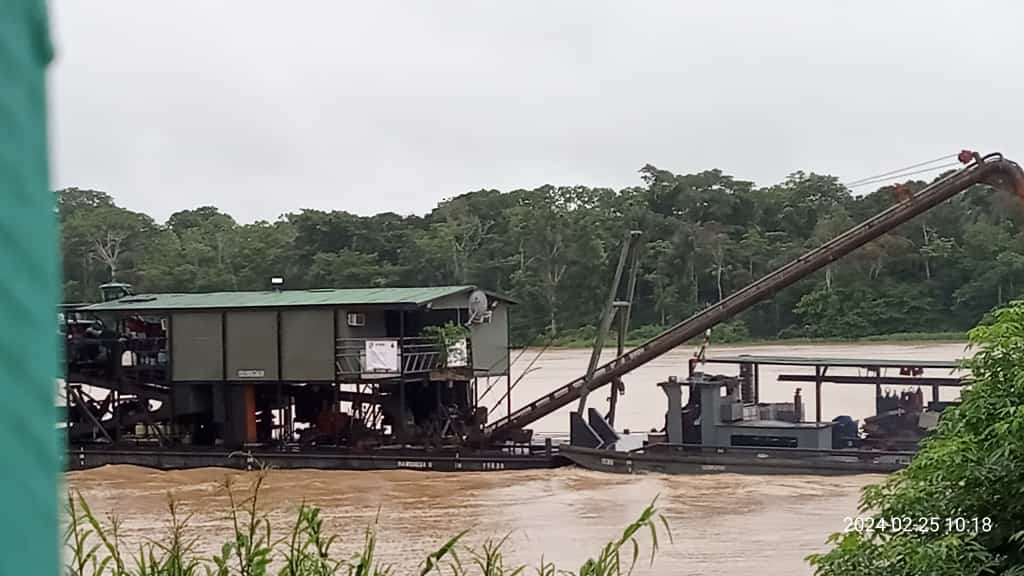
Mining activity has once again become a concern for residents of the Médio Juruá region in Amazonas. On the morning of February 16, a large mining dredge was spotted traveling up the Juruá River, crossing the municipalities of Juruá and Carauari, one of the best preserved regions of the Brazilian Amazon. On the evening of February 26, the same vessel was spotted in the municipality of Itamarati. The case was reported to the Federal Public Prosecutor's Office (MPF) and the Brazilian Institute of the Environment and Renewable Natural Resources (IBAMA).
Employees of the Chico Mendes Institute for Biodiversity Conservation (ICMBio), with the support of the Military Police, approached the raft on February 19, following reports of damages, in the urban area of the municipality of Carauari (AM). After requesting information from ICMBio, those responsible for the vessel presented an Operating License, issued by the Amazonas Environmental Protection Institute (IPAAM), authorizing gold mining in the municipality of Itamarati (AM). However, ICMBio employees found that the various utensils and tools found on the vessel were incompatible with research activities, and were generally used for prospecting.
Applications for mining in the Juruá region are being processed by the National Mining Agency (ANM). However, according to public information available in the agency's own system, none of them have been authorized to date. Mineral exploration in the region is therefore an illegal activity.
In view of this, the Fórum do Território Médio Juruá (Fórum TMJ), a collective of public and private organizations committed to the conservation and sustainable development of the Médio Juruá region, filed, on February 21, a letter of complaint addressed to the MPF and Ibama requesting “immediate and firm action by the control and inspection bodies, in order to prevent the consummation of serious or irreversible damage to the environment, to the health and safety of indigenous peoples and traditional communities, and to the present and future generations who inhabit and live off the life produced by the Juruá River.”
Members of the forum believe that the miners are taking advantage of the strike by Ibama and ICMBio employees to commit the illegal practice. “The urgency is evident in the fact that Ibama and ICMBio have suspended their external activities, especially inspections, which are so necessary in this case. IPAAM, in turn, does not have a base of operations in the cities mentioned. Therefore, environmental inspections are severely hampered,” says an excerpt from the complaint.
The risks of illegal mining
Illegal mining can have serious consequences for the environment, biodiversity and human health, in addition to making sustainable management activities of natural resources that generate income and are the basis of the economy and food security of traditional and indigenous populations unfeasible.
According to the Garimpo Impact Calculator, developed by the civil society organization CSF in partnership with the Federal Public Prosecutor's Office, the mining raft located in Juruá could cause environmental damages valued at 14.5 million reais over a period of one year, equivalent to approximately 40 thousand reais per day of operation. The impacts include silting of the watercourse and mercury contamination. In addition, the calculator estimates that approximately 873 people could be contaminated by mercury, causing various health problems, such as heart problems and loss of IQ.
Third attempt
Two other attempts to invade illegal mining have already occurred in June is at October 2022, when mining rafts were detected transiting and operating in the region. At the time, extractivist leaders were threatened and the case was widely reported by the national and international press.
In this episode, illegal mining did not prosper thanks to the articulation of civil society and the quick action of the responsible bodies. In November 2022, after a complaint filed by the TMJ Forum, Ibama and the Federal Police, with support from ICMBio and the Military Police, set fire to the mining raft that was illegally dredging the Juruá River.
*This text was produced by the Fórum Território Médio Juruá and originally published in OPAN website.
About the Middle Juruá Territory Program (PTMJ)
PTMJ was created in 2017 with the aim of contributing to the sustainable development of the territory, promoting the conservation of biodiversity, sustainable livelihoods and the well-being of traditional populations.
Sitawi raises funds and manages the financial contributions from PTMJ funders. In addition, it also manages programs with local implementers, devising strategies for the development of the Médio Juruá. As the program coordinator, Sitawi expresses its opposition to this illegal exploitation activity and endorses the sovereignty of traditional peoples and populations to be consulted on projects and activities in their territories.
Learn more about our initiatives and mechanisms at Conservation and Climate Finance.